Nobody Told You The Truth About Japan — And That's The Problem Pt. 1
3-part Blog post on Japan
4/20/20265 min read
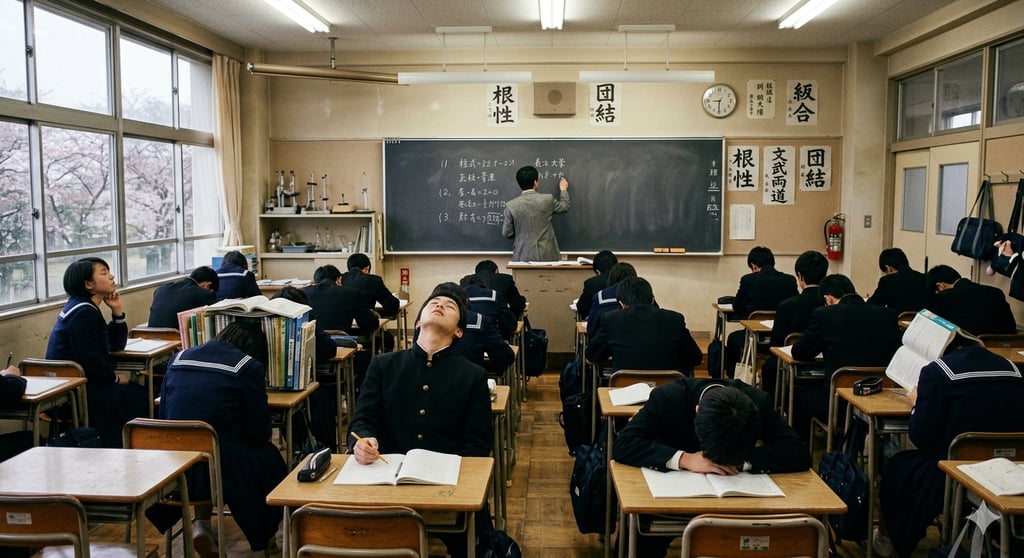
You often hear it — 9 million vacant homes in Japan. Nine million. That number gets cited in government reports, academic papers, and the occasional think piece, and then everyone nods solemnly and moves on. Nobody asks the obvious question: if there are 9 million empty homes in a country where young people can barely afford rent, why is nobody connecting those two facts into something useful?
I've lived in Japan for 34 years. I came here as an outsider and I've remained one — not because I didn't integrate, but because I made a deliberate choice not to lose the perspective that comes with being foreign. And from that vantage point, I want to tell you something that your school, your teachers, and possibly your parents have never said to you directly: the system you're being prepared for is the same system that created this problem, and walking straight into it without question is not a plan. It's surrender.
The Numbers Don't Lie, Even When the Narrative Does
Japan's population peaked in 2008 at around 128 million. It is currently declining at a rate of roughly 600,000 people per year — equivalent to losing a mid-sized city every twelve months. The fertility rate sits at 1.2, far below the 2.1 replacement level. There are currently more adult diapers sold in Japan than baby diapers. By 2050, the population is projected to fall below 100 million, with nearly 40% of those people over the age of 65.
These are not abstract statistics. They describe the world you are inheriting.
Meanwhile, those 9 million vacant homes — called akiya — are scattered across rural towns that once had schools, train stations, local businesses, and communities. Many of them are structurally sound, sitting on land with clean air, space, and a quality of life that urban Japan stopped offering a generation ago. Some are available for as little as zero yen, handed over by municipalities desperate for someone — anyone — to occupy them and pay taxes.
And yet the population of these towns continues to fall. Young people leave for Tokyo, Osaka, and Nagoya, pack themselves into shared apartments the size of a car park, work jobs they didn't choose for companies they don't believe in, and wonder why they feel empty. The irony is not subtle.
Why You Go to School — And Why That Answer Isn't Good Enough
Ask most students in Japan why they go to school and the honest answer, once you strip away the official language, is: to get into a good university, to get a good job, to not embarrass the family. That's it. That is the entire architecture of aspiration for millions of young people, and it is a system designed to produce compliant employees, not creative problem solvers.
I don't say this to be cruel. I say it because the evidence is everywhere. Japan ranks 30th out of 38 OECD countries in student wellbeing. Suicide is the leading cause of death among Japanese people aged 10 to 39. A 2023 survey found that 68% of Japanese high school students feel they have no clear purpose in life. These are not the statistics of a generation that has been inspired. These are the statistics of a generation that has been exhausted into compliance.
The system isn't broken by accident. It was designed this way — to take the natural creativity and risk appetite of young people and sand it down into something manageable. The examination system rewards memorisation over curiosity. Club activities reward conformity over initiative. The entire structure communicates one message from the age of six: don't stand out, don't disrupt, don't ask why.
And the result? Towns with 9 million empty homes and no one with the imagination to see them as an opportunity.
What Nobody Who Lives Inside the Problem Can See
Here is what 34 years as an outsider has taught me. The people closest to a problem are often the least equipped to solve it. Not because they're unintelligent — Japan has some of the most intelligent, diligent, and technically capable people I have ever encountered — but because proximity creates a specific kind of blindness. You stop seeing the problem and start seeing the furniture of the problem. You know every reason why something can't be done. You've heard every objection. You've absorbed every constraint until it feels like gravity.
I don't have that problem. When I look at a depopulating town in rural Shimane or Akita or Kochi, I don't see a community in decline. I see undervalued real estate, untapped cultural assets, a pace of life that a significant portion of the global workforce would pay money to access, and a blank canvas for the kind of creative and entrepreneurial thinking that urban Japan has systematically discouraged.
The people who tell you "you don't live here, so you don't understand the reality" are, with respect, often using that argument to avoid confronting an uncomfortable truth. The reality they're protecting is the same reality that got them here. Fresh eyes are not a liability. They are the only tool that cuts through institutional myopia.
What This Means For You
If you are a student reading this, I am not asking you to drop out, move to the countryside tomorrow, or start a revolution. I am asking you to do something much simpler and much harder: to question the default.
Question why you're studying what you're studying. Question whether the path you're on was chosen by you or chosen for you. Question what it would mean to build something, rather than join something. And seriously — genuinely seriously — consider whether the most interesting, affordable, and wide-open space to do that in Japan right now might be a town that everyone else has decided to abandon.
Because here's the thing about abandoned places. They have no gatekeepers. Nobody is going to tell you you're doing it wrong, because nobody else showed up to do it at all.
There are already young people — Japanese and foreign — who are quietly making this move. They're renovating akiya and turning them into studios, guesthouses, craft workshops, and remote working hubs. They're building small businesses that export local products to global markets. They're finding that a salary that feels modest in Tokyo feels generous in a town where your rent is ¥30,000 a month and you can grow half your own food.
They're not waiting for a government program. They're not waiting for permission. They're not suffering from the myopia that comes from having been told, since kindergarten, to wait your turn.
This series is for people who are done waiting. In Part 2, I'll be talking to the entrepreneurs — the ones who already know the system is broken and are ready to talk about what to build instead.
Paul del Rosario is the Creative Director of Olive Studio and founder of The Itchy Olive, based in Tokyo. He has lived and worked in Japan for 34 years.
If you're a student thinking seriously about a different path — or an educator who wants to bring this conversation into the classroom — visit Bridge to Ventures and Olive Studio.