Nobody Told You The Truth About Japan — And That's The Problem Pt.2
Part 2
4/20/20264 min read
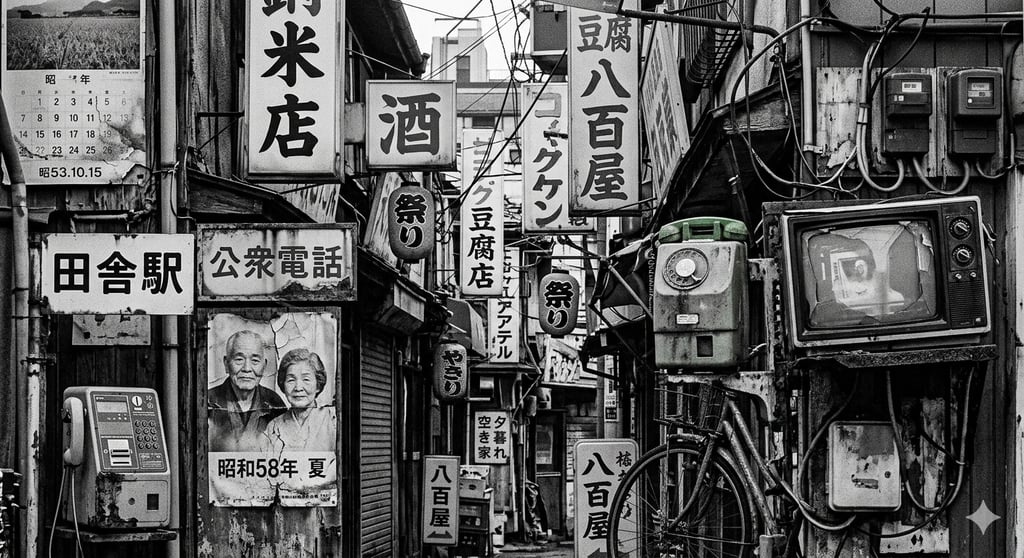
You often hear it — 9 million vacant homes in Japan. And if you're an entrepreneur, or think like one, that number should be keeping you up at night for entirely different reasons than it keeps politicians up at night. They see a crisis. You should be seeing a market.
I want to be upfront about something. I am an educator, not a businessman in the conventional sense. But I have never believed that those two things need to be in opposition. The most useful thing an educator can do — the thing that actually changes lives rather than just filling time — is show people where the real opportunities are, point honestly at the obstacles, and trust that the people in the room are capable of doing something about it. That is what I am doing here. And I would be lying if I said I wasn't also personally interested in building something from this. Good ideas should pay. Helping people and making money are not in conflict. Anyone who tells you otherwise is usually trying to keep one or the other for themselves.
So here is what I see, after many years of watching Japan from the outside.
The Actual Scale of What We're Talking About
Japan currently has 820 municipalities — out of roughly 1,700 — classified by the government as kaso chiiki, or depopulated areas. Of the 900 municipalities officially designated as shōmetsu kanōsei jichitai — communities at risk of extinction — many are sitting on assets that would make any property developer in London or New York physically uncomfortable with envy: traditional architecture, clean water, agricultural land, forests, coastline, and a cultural depth that no amount of urban development can manufacture.
The akiya — vacant home — problem is the tip of the iceberg. Beneath it sits dormant farmland, abandoned commercial properties, underutilised community infrastructure, and local craft and food traditions with genuine global market potential that have never been properly branded, packaged, or distributed. The market failure here is not one of supply. It is one of imagination, risk tolerance, and the right combination of creative direction and technology to bridge what exists with who might want it.
That last part is where this conversation gets interesting.
Why Outside Eyes See What Insiders Can't
I have spent many years watching Japan manage its problems from the inside out. The approach is consistent and, at this point, demonstrably insufficient: identify the problem, form a committee, produce a report, allocate a subsidy, launch a campaign, measure the outputs rather than the outcomes, and repeat.
I am not bogged down by the institutional memory of what has been tried and failed. I don't carry the social obligations that make it difficult for someone inside these communities to challenge the way things have always been done. I see these places the way a good teacher sees a struggling student — not as what they are performing right now, but as what they are genuinely capable of with the right conditions and the right push.
And the right push, in 2025 and beyond, is not a subsidy. It is a combination of honest, courageous place branding and the digital infrastructure to make that brand functional. Platforms that connect local producers to global buyers. Tools that make remote work genuinely viable in rural settings. The kind of visual and narrative identity that makes a specific town feel not like a compromise, but like a deliberate, interesting, and genuinely liveable choice.
The Entrepreneurial Case, In Concrete Terms
Let me give you the numbers that matter, because I am an educator and I believe in showing your working.
The global market for rural and slow tourism — people actively seeking to leave urban environments for authentic, unhurried experiences — was valued at $1.4 trillion in 2023 and is growing at 9% annually. Japan, with its extraordinary density of traditional culture, landscape diversity, and food heritage, is almost comically under-positioned in that market relative to its actual assets.
The remote work market has permanently restructured where knowledge workers can live. A software developer earning a Tokyo salary of ¥8 million a year can live in a renovated akiya in rural Nagano for ¥40,000 a month in rent. That is not a lifestyle downgrade. For many people, it is the life they actually wanted and didn't think was available to them.
The Japanese craft and artisan food market — sake, miso, ceramics, textiles, lacquerware — has significant untapped export potential. Many of the most extraordinary producers in these categories are operating without a coherent brand, without an English-language digital presence, and without a distribution strategy beyond the local. That is not a tragedy. That is an opportunity with a clear entry point and no queue.
The entrepreneur who figures out how to systematically unlock even a fraction of this value — not as a charity project, not as a government program, but as a genuine, scalable business — is building something with a real and growing market, minimal competition from established players, and the kind of story that attracts talent, investment, and press attention.
What I Am Building — And Why I Want You Involved
I started The Itchy Olive and Olive Studio because I got tired of watching good ideas stall inside systems that weren't designed to move them forward. Olive Studio works at the intersection of human creative direction and technology — building the digital infrastructure, brand identity, and platforms that give places and people the reach they've never had. Bridge to Ventures exists to connect the people with the ideas to the people with the will to build them.
I am an educator who believes that the most powerful lesson you can teach anyone is that making something real — something that works, something that pays, something that helps people — is not only possible but is the point. Everything else is preparation.
This is not a pitch for a program or a framework. It is an invitation to a conversation about what is genuinely possible in the places everyone else has written off. If you are building in this space, thinking about it, or simply tired of being told that the safe path is the only path — come and talk.
The conversation starts at Bridge to Ventures. The tools are at Olive Studio.
In Part 3, I'll be addressing the people with the authority to change the conditions on the ground — and making the case that the most useful thing they can do right now is create the space for people like you to operate in.
Paul del Rosario is the Creative Director of Olive Studio, founder of The Itchy Olive, and an educator based in Tokyo. He has lived and worked in Japan for many years.